Insights

Publishers Weekly Presents The Who's Who Of Self-Publishing

So apparently Publishers Weekly -- who I used to have quite a bit of respect for -- has decided to "embrace the self-publishing phenomenon" and create a "quarterly supplement announcing self-published titles and reviewing those we believe are most deserving of a critical assessment." But wait -- there's more!

This whole shebang costs you only $149! (You could buy a new Kindle for less than that.) Of course, some of the e-books submitted will be reviewed. It's not like you're paying to have your stuff reviewed. PW would never lower themselves to that, would they?

We briefly considered charging for reviews, but in the end preferred to maintain our right to review what we deemed worthy. The processing fee that guarantees a listing and the chance to be reviewed accomplishes what we want: to inform the trade of what is happening in self-publishing and to present a PW selection of what has the most merit.

Ah, yes, well it's good to see that they haven't decided to sell out completely. After all, they are professional. Then again, this entire "supplement" is nothing more than a way to make self-published authors pay for ad space. And you know what that eerie voice in Kevin Costner's corn field says: "If you build it, they will come." (Yes, yes, the actual quote is "he will come," but you get the idea.)

And, sadly, I guarantee self-published authors will come in droves with their wallets open.

* * *

In other news, I've added a new widget to the sidebar of upcoming appearances for the Hint Fiction anthology's release. The Vroman's and McNally Jackson events I've mentioned already, but there will also be an event at the Big Blue Marble Bookstore in Philadelphia on Friday, November 19. I have also been asked to speak at the Morgantown Poets gathering on Thursday, December 16; this is in Morgantown, West Virgina for anyone close by. And there will most likely be something around my area on Monday, November 1st, but nothing has been decided yet. Once I get a full list of anthology contributors attending each event, I'll make an official announcement.

* * *

The Los Angeles Review's fiction editor Stefanie Freele asked me to do a blog post for their website. I wrote a little something called "Our Best Work" and you can read it here.

* * *

You're probably wondering why I'm blogging when I said I wouldn't be for awhile. Well, that Publishers Weekly thing really ticked me off for starters. Work on the Y.A. book is coming along nicely, and I'm on the downswing, really getting momentum, so it would make sense that I would have to put off writing for a few days. This Wednesday I'll be headed to Las Vegas; my brother-in-law is getting married so my wife and I will be there for a few days to attend, and I'm not about to take my laptop along with the intention of continuing to work on the book. I mean, I could take my laptop, but we all know I wouldn't get any writing done.

So ... yeah, that's about it. Hope everyone's doing well. I must now go rewatch The Hangover in anticipation for this week. I wonder if they have some kind of bus tour dedicated to the movie. It wouldn't surprise me if they did.
The Predictable Unpredictability of Publishing

Anyone can predict the weather, but it doesn't mean it will rain or snow or be sunny. What happens happens, and there's really nothing any of us can do about it.

That's especially true in publishing.

Take me for instance. Ever since I was in middle school I wanted to be a writer. Through the years, I came up with a game plan that I did my best to follow. I wouldn't settle for second best. I knew I wanted to be published and published big, so I searched for an agent. After years and years and writing different novels, I finally got an agent, and I knew -- just knew -- that I had made it. But the first book didn't sell, as neither did the second. In the end I parted ways with my agent, and wrote another novel, and got a new agent. And I knew -- just knew -- that this was going to be the one. But the book he shopped around didn't sell, as neither did the next book.

Then I write a little essay that isn't supposed to be read by more than a dozen people and suddenly words gets around and a publisher contacts me and my agent about doing a book. (For those newer to this blog, details of what went down can be found here.)

Is this how I always envisioned myself entering into the wild and wacky world of publishing? Not at all. But it's a start, and I'm more than happy to take it.

Most importantly, there was no way anyone could have ever predicted that would happen.

No way at all.

Just like with what happened recently with my friend Joe Schreiber. If you remember from a few blog posts back, he finally sold his young adult book Au Revoir, Crazy European Chick. Despite having been rejected by a number of other houses, Houghton Mifflin picked it up in a two-book deal. Great, right?

Well, earlier this week it was reported that Paramount won the movie rights in a very aggressive bidding war with Fox for a nice chunk of change. How friggin' fantastic is that? I remember having lunch with Joe months and months ago, talking about an early draft of his manuscript, and never once did either of us ever imagine that something like that would happen. But it did, and it couldn't have happened to a nicer and more deserving guy.

So predictability? You just can't do it. You can want something to happen, but it certainly doesn't mean it will.

The other day my agent called. He had just finished reading my new novel, a thriller. He liked it, but had one issue. He told me what that issue was. I said, "That's a pretty major factor in the entire book." He said, "Well, yes and no." He gave me some ideas and then said that if I didn't want to work more on it, he would be willing to go out with it as is.

I could have gone the easy route. The lazy route. I could have just told him that yeah, take it out as is. But doing that would have been extremely stupid of me, and I like to think I'm not a stupid person.

As writers, it's important to understand one basic fundamental truth: we are not as good as we'd like to think we are. In fact, we will probably never be as good as we'd like to think we are. And we need to remind ourselves of that daily. Because when we start to believe we're as good as we think we are, that's when the true laziness sets in and our writing starts to fall apart. We should always be trying to make our work as good as we can make it, and then try to make it even better.

My novel? I understand my agent's concern with it, and I plan to fix it. I think I even know how. But by doing so involves a pretty lengthy revision. Almost a rewrite. The story itself isn't changing, but still many, many chapters need to be reworked. But it's okay, because in the end I know it'll be worth it.

Well, hopefully.

But as I mentioned before, I'm currently working on a Y.A. novel. I plan to finish that first, then start up the reworking on the thriller. Which means that it'll be pretty quiet around this ol' blog for awhile. Don't expect many posts from me unless it's purely promotional stuff for the anthology (and with the release date quickly approaching, there will be many). Maybe there will be a random post here and there, but for the most part, I want to concentrate more on these books. I'll still be active on Twitter, of course, and somewhat active on Facebook, so hit me up there.

For now, though, I leave you with a different bit of unpredictability. In case you haven't seen it yet, a woman went through the drive-thru of McDonald's and wanted McNuggets. It was still breakfast time, and they told her sorry, no McNuggets. And this woman, she freaked. There's no audio for the clip, so I also included a video of the McNugget rap. Play them both at the same time (or start the rap video around the 20 second mark of the first video for optimal enjoyment) and watch the crazy lady go crazy.

httpv://www.youtube.com/watch?v=-Eu_Vvnh6ko

httpv://www.youtube.com/watch?v=XSZ6k3QIsAk

Y.A. Shmy.A.

According to surveys by the Codex Group, a consultant to the publishing industry, 47 percent of 18- to 24-year-old women and 24 percent of same-aged men say most of the books they buy are classified as young adult. The percentage of female Y.A. fans between the ages of 25 and 44 has nearly doubled in the past four years. Today, nearly one in five 35- to 44-year-olds say they most frequently buy Y.A. books. For themselves.

--- Pamela Paul, New York Times essay

Young Adult fiction is all the rage these days, it seems. Not only are the books read by "young adults," but also by (gasp) "adults"! It seems that, like graphic novels, Y.A. fiction has branched out and become more accepted among mainstream readers (and really, just what does "mainstream" readers mean? That's like using the term "average American")

Which is great, because I'm currently halfway through writing a Y.A. novel of my own. The idea is one I've had for years but never did anything with. I was always too worried that it might be too similar to something else. But then I realized I wouldn't know until I wrote it so I decided to write it. But it, like a solid majority of recent Y.A. fiction (as noted by Laura Miller's New Yorker article), is somewhat dystopian both in tone and structure.

Actually, what am I talking about -- it's completely dystopian in every way imaginable. Which, on the one hand, can be a good thing, as that seems to be the hot ticket right now (see Suzanne Collins and others), but on the other hand it can be a bad thing, as sometimes there is too much of a good (or rather marketable) thing -- like the upsurge of secret history novels after The Da Vinci Code’s wild success.

Of course, not all Y.A. has to be dystopian, as evidenced by my buddy Joe Schreiber's recent sale of his YA thriller Au Revoir, Crazy European Chick to Houghton Mifflin. I've had the pleasure of reading an early draft of the novel, and it's good. Really good. And, unlike the recent trend, it's not futuristic or features overpowering governments bent on brainwashing its people.

But just what, exactly, makes Y.A. Y.A.?

Is it that it features a teenage protagonist? That it deals with issues relevant to young adults? Because if that's the case, then it seems strange that more and more adults are reading them (though, let's be honest here, the issues young adults face are pretty much the same as the issues adults face). But, as mentioned in the Pamela Paul essay, "A lot of adult literature is all art and no heart. But good Y.A. is like good television. There’s a freshness there; it’s engaging."

Plus, as less and less adults read books (what is the average nowadays, a book a year?), it can also be more profitable. And that, my friends, is never a bad thing.

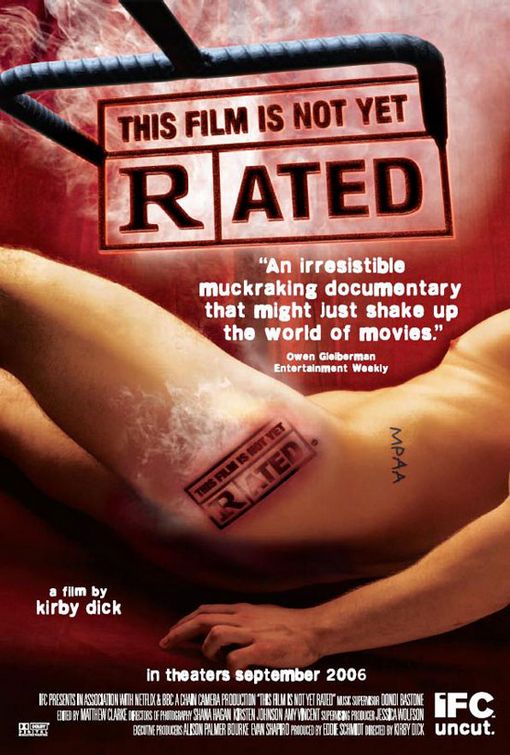
This Blog Is Not Yet Rated

The other night I had a chance to watch the documentary This Film Is Not Yet Rated, which takes a very close and scrutinizing look at the MPAA (Motion Picture Association of America) and its rating system. Basically, the system was set up so films would no longer have to be censored, only, in a way, films are being censored as a rating such as PG-13 or R or NC-17 can make or break a movie. There are no guidelines for what ratings movies get; an anonymous group of people (supposedly average American parents) watch movies and base their decisions on nothing more than their feelings. The film examines the inconsistencies displayed by the MPAA and does some investigating to find out who these anonymous people are.

Anyway, if you're a moviegoer, it's definitely worth checking out. And, of course, it made me wonder what would happen if there was such an anonymous group who rated books. Just imagine: on the back of every book, there is some kind of rating, maybe a quick description of whether or not there is foul language, nudity (?), violence, drug use, etc. (Yes, yes, children's and YA books do sometimes have suggested reader ages on the back, or at least so did some of the books I've seen.)

Except, oftentimes, it is the publishers who do the censoring. Or rather, the editors decide what needs to be taken out of a book, what might make it too racy (though there have been occurrences where booksellers, like Wal-Mart, will refuse to carry a title based on the content and sometimes even the cover, and that forces publishers to be even more hesitant about what they publish).

Then again, what does censor even mean?

Many years ago, I sold a story to an upcoming horror magazine. The pay wasn't bad (three cents per word) and I was really happy to be in the magazine to begin with. But the editor, he wanted me to change the story up a bit. Basically, despite the fact it was a horror magazine, he wanted to keep it clean in terms of language. So there had been a few F words in my story that I changed around. No big deal. I didn't feel like I was making a big sacrifice by nixing those swear words. The editor also wanted me to change a very small part, where the main character becomes aroused. I think the original wording was something like "he felt his dick hardening" and the editor wanted me to tone that down, so we went with something like "he felt himself becoming aroused." Again, no big deal. The editor wanted to publish my story. He was paying me. If he wanted me to change around a few things, no big deal. It was his magazine, after all, and truthfully, I preferred that he worked with me on changing the story around instead of just doing it himself (which some editors are known to do).

Was I being censored? No. I was being edited. The changes didn't greatly alter the story in any way. It wasn't like he wanted me to rewrite the ending and fill it with rainbows and unicorns (though that may have been interesting, now that I think about it).

Some writers in my position may have refused. It's their story, and they want it published as is. Which, obviously, is very hard-headed thinking. At a certain point, a writer has to let go of his or her work.

Of course, there is a line between editing and censoring. And trying to point out the differences between the two could open a can of worms, so I'm not even going to try. Because my interpretation of editing and censoring would no doubt differ from many others' interpretations. Like I said, some would think the editor was trying to censor me by getting rid of those F words and changing around that one sentence. I didn't see it that way. So far I don't believe I have ever been censored (well, except one time in high school, but that's a story for another time), but when the time comes, I'm confident I'll know it.

Now I leave you with a shaky video of Matt Stone explaining how they added to the sex scene in Team America knowing that the MPAA would want them to cut stuff out. Just watch, you'll see what I mean:

httpv://www.youtube.com/watch?v=eHHHHozaAWQ

Plotting The Outline

Recently I've begun watching the television series 24. My local library had a couple of seasons on DVD, and I ended up going through marathon sessions (I just finished season five). Basically, when I get a new season, nothing else (reading or writing) gets done. I watch episode after episode. I can't understand how people could have watched the series during the regular season, having to wait an entire week before the next episode, one that would, inevitably, leave off with a cliffhanger.

Yes, the show can be frustrating. You can piece apart all the problems. But in the end it's great mindless fun. I could watch Jack Bauer torture terrorists all day. Which I know it an awful thing to say, because terrorists don't really mean to cause so much death and destruction. I mean, it's not like it's their mission in life to kill us all, so God forbid we put them through some discomfort. (note: sarcasm level is at an all-time high.)

Anyway, for a show like 24, everything depends on an outline. I'm sure the producers didn't let them start filming until they had the entire story already written down. And honestly, doing a show like 24, it's tough to do twenty-four episode that had enough action and drama in each episode and that also ended with cliffhangers. They (the writers and producers) could only do so much. They had to keep viewers tuning back in week after week, right?

Personally, I don't like the idea of outlining. It makes the process of writing more of a, well, process. You become restricted to the outline. You become to depend on it. All the novels I've written, I've never outlined. I always have a very good sense of where the story is going and where it will end up (outlining in my head, I guess), but I never put it down on paper. I like the freedom of telling the story as it happens in my head, not as it happens on the outlined page. (Of course, I haven't sold any novels, so what does that tell you?)

Last week thriller writer Lisa Gardner was quoted as saying:

[O]utline your book, scene by scene, on individual note cards. If you've written the novel, then go through it and break it down into its individual building blocks.

Apparently she "uses these cards to physically map out her book on the floor, actually visualizing the flow of the novel."

Sometimes I guess an outline is needed. I remember reading somewhere how Scott Smith extensively outlined A Simple Plan before he even started writing. Which makes sense, because that novel follows a very strict arc of events.

Harlan Coben, however, shares my viewpoint (or maybe I share his viewpoint, whichever way works for you):

I don’t outline. I usually know the ending before I start. I know very little about what happens in between. It’s like driving from New Jersey to California. I may go Route 80, I may go via the Straits of Magellan or stopover in Tokyo … but I’ll end up in California.

One of my novels was never even supposed to be a novel. I'd figured it would be a novella at the most. But as I was writing I had the protagonist and another character walking out of a building, and as they walked they passed a janitor with his head down. What that janitor was doing there, I didn't know (it was just one of those things that appeared), but a few chapters later I understood what the janitor was doing there (hint: up to no good), and it turned the story that I thought was going to be a novella into a novel of about 120,000 words.

All because of one character who, at the time, wasn't even a character.

That wouldn't have happened had I outlined the novella ahead of time. I would have felt compelled to stick to what was on the page, even if the janitor did appear.

So what does this all tell us? I hate to regurgitate the same thing, but that every writer is different. What works for one may not work for another. We just have to feel out what works best for us and go with it, despite some writers claiming that you have to do something a certain way. I always hate that: writers saying you must do something such-and-such a way.

Years ago, David Morrell told me I couldn't write a novel in the second person. He wasn't being unkind about it; he was just being matter of fact. We were having drinks in the hotel bar, him and me and Douglas Winter. He said a short story, sure you can write in the second person, but not a novel.

And you know what?

I still went ahead and wrote that novel. And my first agent shopped it around. And while there were a few nibbles, there were no bites, but that didn't discourage me. I was glad I'd written it, mostly because I was told I couldn't.

Oh, and that novel? You better believe I wrote it without an outline.