Writers Without Borders

So it happened yesterday. It being Borders finally filing for bankruptcy. If you've been keeping up with publishing news, this shouldn't have been surprising at all. I personally believe they hammered the final nail in the coffin when they decided not to get into the whole e-book game. Yes, they sold the Kobo and Sony readers, but neither of those were a Borders reader, not like how Barnes & Noble has the Nook. Anyway, it's certainly sad, though I know there are some people out there rejoicing. Yes, you know who I'm talking about. Some writers who have been having great success with their self-published e-books. I don't begrudge them anything, though it does get under my skin how some of these writers for years and years claimed to love booksellers, and would do anything for booksellers, but then, once it became clear they no longer needed booksellers, basically gave them all the finger. Yeah, that right there is a real douchebag move.

This PDF gives a list of all the Borders stores that are closing. Is your local Borders on it? My local Borders isn't, though I wonder why. Just the other night my wife and I were in there, and it was pretty deserted. We'd gotten an Olive Garden gift certificate so we had decided to, you know, go to Olive Garden, but the wait was pretty long as is expected on a weekend night. Luckily, there's a Borders right next door. The people who were there, it seemed, were just waiting for their Olive Garden buzzer to go off. I didn't really see anybody intent on buying books. Maybe that's because they didn't have the Hint Fiction anthology in stock, who knows.

The other group of people were the ones occupying the cafe. Yes, you know the group I'm talking about. You might even be one of them. Yesterday Brian Keene posted what he thought was the real reason Borders filed for bankruptcy, and I have to say, it makes a lot of sense. Basically, people going in there to use the free WiFi and drink coffee and look at books but not actually buying any books.

Also yesterday Nick Mamatas posted an interesting anecdote on Facebook about his first novel Move Under Ground (which has just recently become available on Kindle):

Back when MOVE UNDER GROUND came out in paperback, the print run was based on a fairly large, if tentative, buy from Borders. The BGI buyer reversed course and actually bought zero copies, claiming that the book was "more sophisticated" than he was comfortable placing in the horror section.

A long time ago, publishes published the books they wanted to publish and the booksellers sold those books. Then, at some point, a shift began to occur, where the booksellers began to have more and more say over what the publishers published. Now, from what I understand, some publishers sometimes approach major booksellers first about a particular book to see if they would have interest in selling it before they even decide to publish it.

My supernatural thriller The Calling which I announced on Monday has the same sort of backstory. Basically, it's a complex novel in the Peter Straub vein. Peter Straub can get away with writing really complex novels because he's Peter Straub, but newer writers have a tougher time sliding them past publishers. There was a lot of great feedback from publishers on the novel who liked it but had to pass for various reasons, but the best (or worst?) was one editor saying she loved it but felt it was "way too complex for most readers."

And so such is life.

But what, exactly, constitutes "most readers"? It's really fascinating when you think about it. How Hollywood decides what audiences want to see, just as New York publishers decide what readers want to read. They say our culture is getting dumber and dumber, but who's to blame? Hollywood and New Yorker publishers for lowering the bar, or movie audiences and readers for allowing them to lower the bar (or are we really just getting dumber that it wouldn't be beneficial for Hollywood and publishers to try to raise the bar up anymore than what it already is)? Is James Patterson a major success because he writes great novels, or is he a major success because the bookstores make sure his new book is the very first one you see when you walk inside the door, the only option you have in the small airport bookstore while you're waiting for your flight, etc.?

Who knows, and quite frankly, who cares?

What you should care about, if you want to break into traditional publishing, is just what Borders apparently owes publishers:

Publishers are on the hook for hundreds of millions of dollars led by Penguin Group (USA) which is owed $41.1 million, followed by Hachette at $36.9 million, Simon & Schuster at $33.8 million, Random House at $33.5 million, and HarperCollins at $25.8 million. Neither major book distributor, Ingram or Baker & Taylor were among the leading creditors, and only one book distributor, National Book Network, which is out $2 million. The filing listed $1.27 billion in assets and $1.29 billion in liabilities. Borders said it expects to be able to pay vendors for merchandise shipped to it after today’s filing 16; those owed money prior to the filing will only be paid with the approval of the bankruptcy court.

That's a lot of moolah there, no? And in the end, who is going to suffer first, the publisher or the writer?
The Tale Of Two Covers

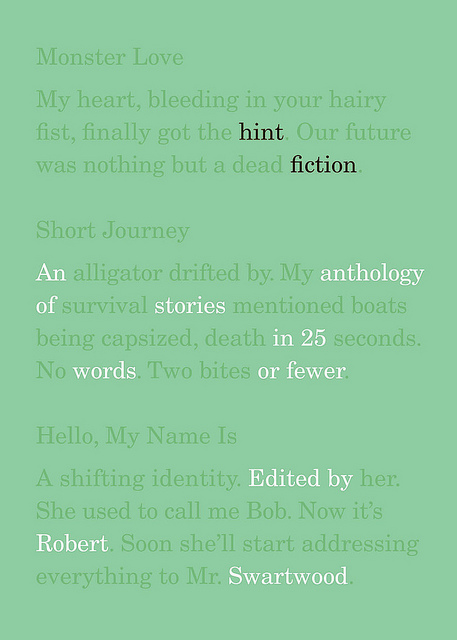
Remember back when I announced that the Hint Fiction anthology was getting a second printing? Well that second printing it out now -- has probably been out for awhile -- but I just happened to see some of the copies last week at AWP. And there are changes. Nothing too major -- just a few typos corrected on the copyright page -- but there is a difference with the cover. Here's the cover of the first printing:

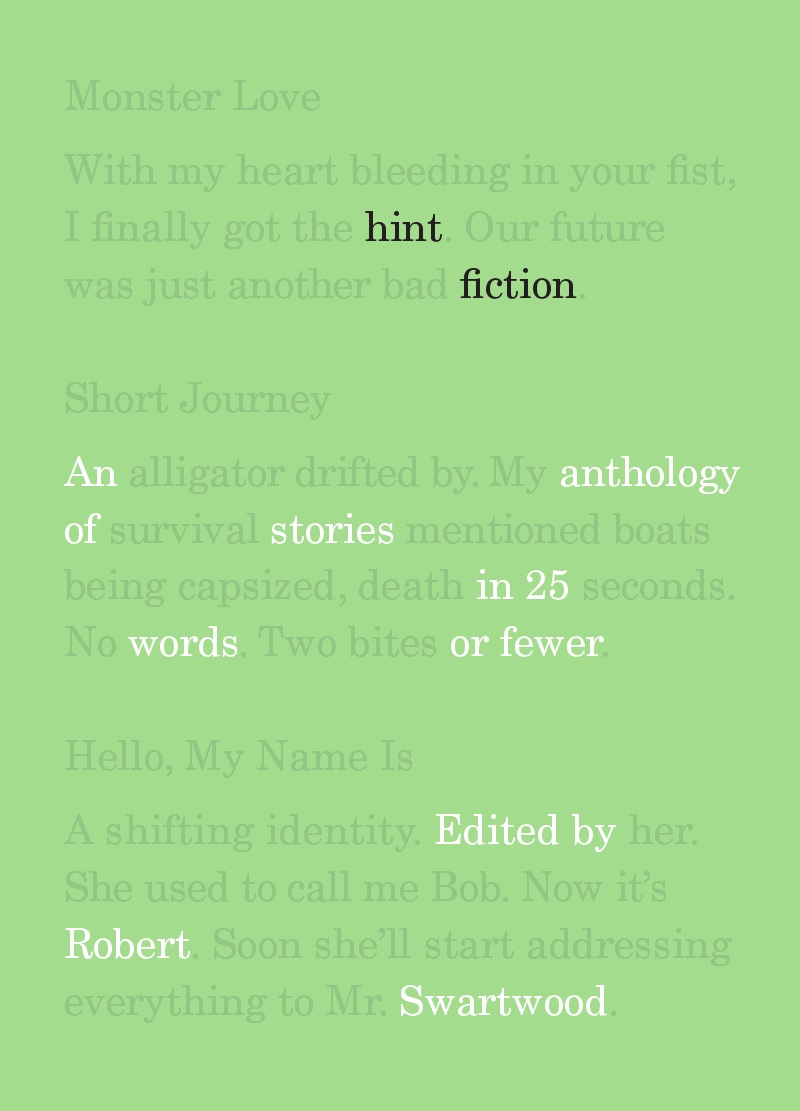
Now here's the cover of the second printing:

Despite the obvious contract in color (and why the colors are different is beyond me; the actual printed books are the same color), notice any differences?

The wording of the first story, "Monster Love," is different. You see, the second printing's version is the preferred wording, at least on my end. We -- the publisher, the designer, myself -- had gone back and forth on the story. I didn't care for the personification of heart. I also didn't care for the "hairy fist" part, thinking it was too much for a story already titled "Monster Love." So I asked for the simpler version; the publisher agreed and everything was set to go with that version ... except somehow the wrong files got sent and the first version -- the "hairy fist" version -- was what was printed. But Norton, being the class act that they are, promised to change it for any future reprintings, and they did.

So what's the point? Well if the anthology continues to do well and gets reprinted again and again, that first edition with the "hairy fist" cover could be considered, in some circles, a collector's item. Just sayin'.

Coming Soon To An E-Bookstore Near You

When eighteen-year-old Christopher Myers’ parents are murdered, something is written on his bedroom door, a mark in his parents’ blood that convinces the police the killer has targeted Christopher as the next victim. To keep him safe, he travels away with his estranged grandmother and uncle to the small town of Bridgton, New York. And it’s in Bridgton that he meets an extraordinary young man who has come with his father to stop an unrelenting evil. Soon Christopher learns of the town’s deep dark secret, and how his parents’ murder was no accident, and how he has been brought to Bridgton by forces beyond his power—forces that just may threaten the destruction of all mankind.

"The Calling is a powerful, gripping and terrifying novel, the sort that possesses your whole life while you’re reading it; it’ll stalk you through the day, and inform your dreams. Swartwood has delivered a novel that will become a classic."

— Tim Lebbon

"Robert Swartwood’s The Calling is a diabolical rocket sled of a psychological thriller. Told through the vivid, almost druggy point of view of a young man on the edge, tangled in a web of tragedy and surreal horror, Swartwood’s novel gets under the skin and stays there. Highly recommended."

— Jay Bonansinga

Making Connections

Did you know Carol Edgarian, one of the co-founders of Narrative Magazine, has a new book coming out? Neither did I. The only reason it came to my attention is because I noticed some traffic coming from her official publisher page at Simon & Schuster. It includes her picture, her bio, info about her book, her tour info, and links "From the Blogs." One of those blogs is currently my own, the post I did back in December where I made fun of the fact that Narrative was begging for donations. How long before the publisher notices this mishap and promptly deletes that link? Who knows. But when it happens, I at least grabbed a screenshot to give me a good chuckle every now and again.

So is this the exciting announcement I mentioned in my last post? No; no, it is not. That's tomorrow. Y'all come back now, ya hear?

Saturday Stuff: More On E-Book Royalties, TwitLonger, Best Of EDF 3, American Grindhouse

Earlier in the week I talked about e-book royalties and what the Authors Guild had to say. Just yesterday they released a new part of their ongoing series, this one aptly titled "The E-Book Royalty Mess: An Interim Fix":

Negotiating a publishing contract is frequently contentious, but authors have long been able to take comfort in this: once the contract is signed, the interests of the author and the publisher are largely aligned. If the publisher works to maximize its revenues, it will necessarily work to maximize the author's royalties. This is the heart of the traditional bargain, whereby the author licenses the publisher long-term, exclusive book rights in the world's largest book market in exchange for an advance and the promise of diligently working to the joint benefit of author and publisher.

Now, for the first time, publishers have strong incentives to work against the author's interests.

As we discussed in our last alert, authors and publishers have traditionally acted as equal partners, splitting the net proceeds from book sales. Most sublicenses, for example, provide for a fifty-fifty split of proceeds, and the standard hardcover trade book royalty -- 15% of the retail price -- represented half of the net proceeds from selling the book when the standard was established. But trade book publishers currently offer e-book royalties at precisely half what the terms of a traditional proceeds-sharing arrangement would dictate -- paying just 25% of net income on e-book sales. That's why the shift from hardcover to e-book sales is a win for publishers, a loss for authors.

The piece goes on. Definitely worth checking out.

*  *  *

I love Twitter. I don't know why. If I had to choose between Twitter and Facebook, I would take Twitter in a heartbeat. There's just a simplicity to it that I really like. Also I really dig the fact that each tweet can be no more than 140 characters. And I'm not just saying that because I'm the "Hint Fiction guy." I believe it really can help writers work on their word-choice and self-editing. Of course, a few tweeters out there will run on and on, which sorta defeats the purpose. You know what else defeats the purpose? Services like TwitLonger.

On some level I've always known this service to exist but never bothered with it. Why would I, when the simple point of Twitter is to keep your posts nice and short. But recently a new upgrade with TweetDeck (which I use mostly for my desktop tweeting) has this service enabled. Before when I would tweet and go over the 140 character mark, the numbers would turn red and show a negative. Now, however, it just continues, as if encouraging you to keep typing away and not worry about the limit. This is sad and goes against everything Twitter stands for.

My point? That servies like TwitLonger really suck. And if you use them, shame on you. Shame!

*  *  *

On a brighter note, the table of contents has been announced for the third edition of The Best of Every Day Fiction. It includes online friends Gay Degani, Aaron Polson, Ben Loory, and many, many more. It also include my story "Multiplicity." A big thanks to Jordan Lapp and Camille Gooderham Campbell and the rest of the EDF team for not only publishing my story in the first place, but for now reprinting it. When the book becomes available, I'll be sure to post about it here.

*  *  *

Everyone have a nice and safe romantic weekend. Tune in Monday for an exciting announcement (at least, I hope it'll be exciting). In the meantime, American Grindhouse!

httpv://www.youtube.com/watch?v=AndtsMdk2fc