
I guess it was inevitable that this movie would get made. And of course it just has to be in 3-D! Because, you know, it's become an industry requirement to make all crappy movies 3-D.
httpv://www.youtube.com/watch?v=JLMoubBxt_0
MUSINGS
I guess it was inevitable that this movie would get made. And of course it just has to be in 3-D! Because, you know, it's become an industry requirement to make all crappy movies 3-D.
httpv://www.youtube.com/watch?v=JLMoubBxt_0
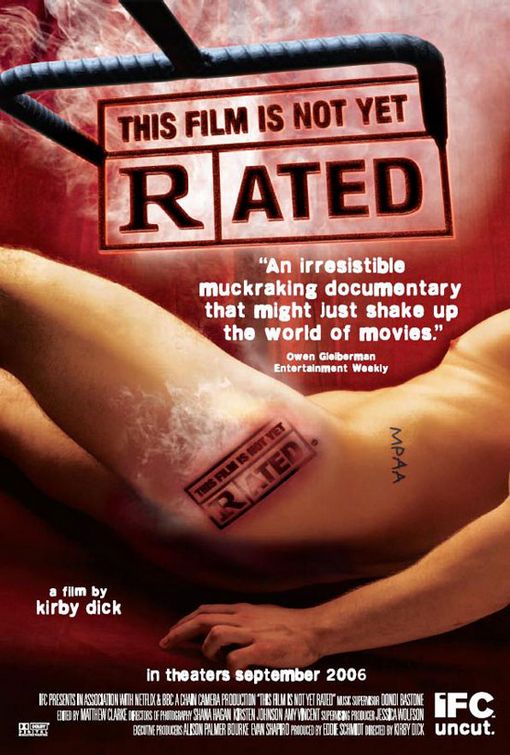
The other night I had a chance to watch the documentary This Film Is Not Yet Rated, which takes a very close and scrutinizing look at the MPAA (Motion Picture Association of America) and its rating system. Basically, the system was set up so films would no longer have to be censored, only, in a way, films are being censored as a rating such as PG-13 or R or NC-17 can make or break a movie. There are no guidelines for what ratings movies get; an anonymous group of people (supposedly average American parents) watch movies and base their decisions on nothing more than their feelings. The film examines the inconsistencies displayed by the MPAA and does some investigating to find out who these anonymous people are.
Anyway, if you're a moviegoer, it's definitely worth checking out. And, of course, it made me wonder what would happen if there was such an anonymous group who rated books. Just imagine: on the back of every book, there is some kind of rating, maybe a quick description of whether or not there is foul language, nudity (?), violence, drug use, etc. (Yes, yes, children's and YA books do sometimes have suggested reader ages on the back, or at least so did some of the books I've seen.)
Except, oftentimes, it is the publishers who do the censoring. Or rather, the editors decide what needs to be taken out of a book, what might make it too racy (though there have been occurrences where booksellers, like Wal-Mart, will refuse to carry a title based on the content and sometimes even the cover, and that forces publishers to be even more hesitant about what they publish).
Then again, what does censor even mean?
Many years ago, I sold a story to an upcoming horror magazine. The pay wasn't bad (three cents per word) and I was really happy to be in the magazine to begin with. But the editor, he wanted me to change the story up a bit. Basically, despite the fact it was a horror magazine, he wanted to keep it clean in terms of language. So there had been a few F words in my story that I changed around. No big deal. I didn't feel like I was making a big sacrifice by nixing those swear words. The editor also wanted me to change a very small part, where the main character becomes aroused. I think the original wording was something like "he felt his dick hardening" and the editor wanted me to tone that down, so we went with something like "he felt himself becoming aroused." Again, no big deal. The editor wanted to publish my story. He was paying me. If he wanted me to change around a few things, no big deal. It was his magazine, after all, and truthfully, I preferred that he worked with me on changing the story around instead of just doing it himself (which some editors are known to do).
Was I being censored? No. I was being edited. The changes didn't greatly alter the story in any way. It wasn't like he wanted me to rewrite the ending and fill it with rainbows and unicorns (though that may have been interesting, now that I think about it).
Some writers in my position may have refused. It's their story, and they want it published as is. Which, obviously, is very hard-headed thinking. At a certain point, a writer has to let go of his or her work.
Of course, there is a line between editing and censoring. And trying to point out the differences between the two could open a can of worms, so I'm not even going to try. Because my interpretation of editing and censoring would no doubt differ from many others' interpretations. Like I said, some would think the editor was trying to censor me by getting rid of those F words and changing around that one sentence. I didn't see it that way. So far I don't believe I have ever been censored (well, except one time in high school, but that's a story for another time), but when the time comes, I'm confident I'll know it.
Now I leave you with a shaky video of Matt Stone explaining how they added to the sex scene in Team America knowing that the MPAA would want them to cut stuff out. Just watch, you'll see what I mean:
httpv://www.youtube.com/watch?v=eHHHHozaAWQ
First, some Hint Fiction news:
Now, to set the record straight, I love Google. It's probably one of the greatest things in the world. I don't even know why other search engines try when Google has the market cornered. I mean, the friggin' word had become a verb. Nobody Yahoos or Bings something; no, they Google it. Anyway, the auto suggestion is great, too. It gives one an idea of what a lot of other people are searching. I think in a thousand years, when civilization has crumbled and those digging through the mess want to learn about our culture, all they'll need to look at are some screen shots of Google's auto suggestion. Like Hint Fiction, for example:

Pretty neat, huh? And of course that auto suggestion will change as time goes on. But right now, July 31, 2010, that's what is there.
Now with Google's auto suggestion in mind, I thought I'd try to go through the six basic questions of who, what, where, when, how, why and see what Google comes up with. I'm sure this has been done before (I wouldn't be surprised if Jimmy Chen did something like this at HTMLGIANT), but I haven't seen it yet, so I figured what the hey (my favorites, without a doubt, are the second suggestion for where and the third and tenth suggestions for why). Enjoy.


Today, according to Smashwords, The Silver Ring has been downloaded 1,000 times at the site. What this means exactly, I'm not quite sure. Even though someone downloads it -- and with Smashwords you can download a number of different formats -- it doesn't necessarily mean anyone is actually reading it (which, despite what some people may say, I think is the most important part). Sale numbers and download numbers are nice, but even with 1,000 downloads, what exactly does that mean? If people are reading it, are they enjoying it or hating it or just very indifferent about it? The novella has been reviewed twice at Amazon, a few times at Goodreads, zero times at Smashwords, and Barnes & Noble has this thing where you can just put star ratings, and according to the site, it has been reviewed eight times with only one customer review:
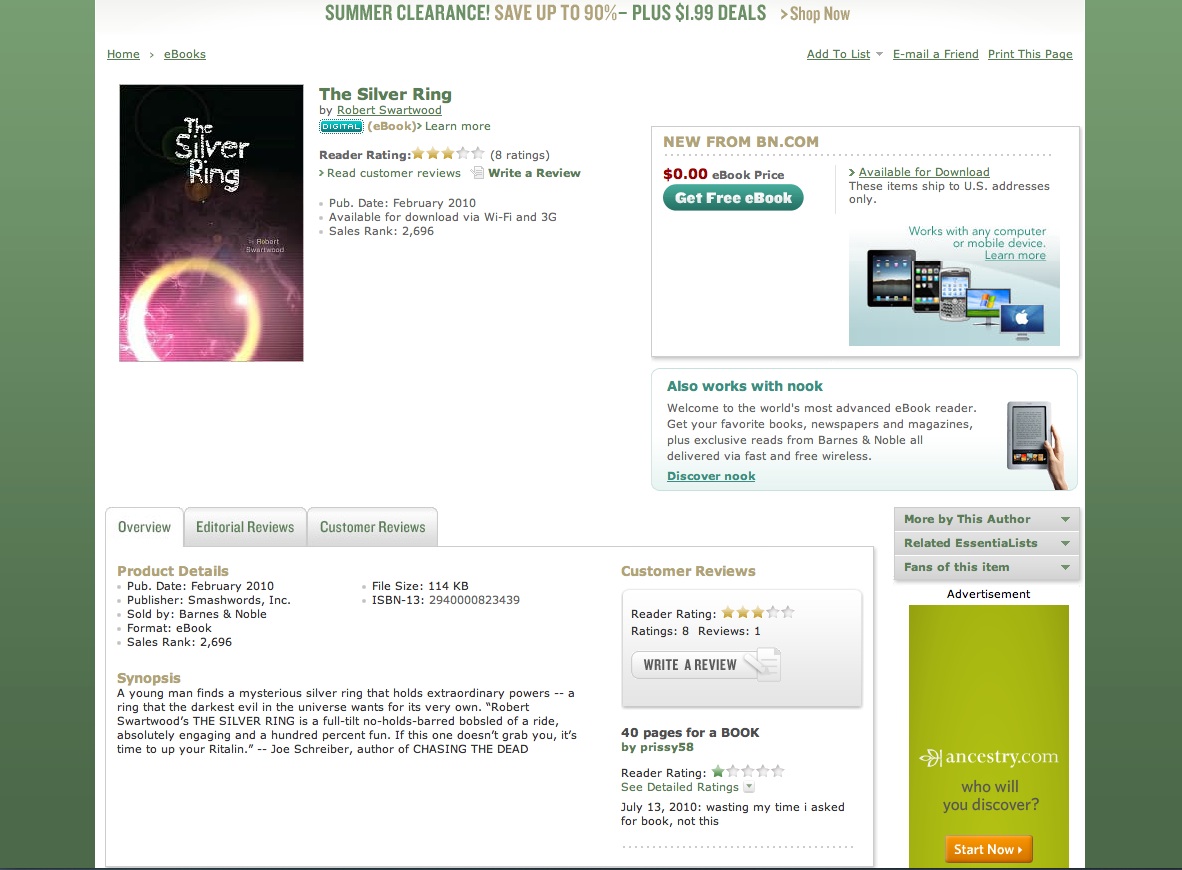
Not sure if you can see the customer review there at the bottom right-hand corner, so here it is closer up:
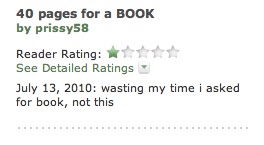
Um, yeah. Everyone always says how Amazon reviewers are the crazy ones, but I think we just found one here at B&N. Personally, I think it's hilarious ... at least from what I can even understand based on the "review" written. Apparently this prissy58 is upset that she wasted her time on a very short book which, mind you, is free. Also, the introduction at the front of the novella states the length, but whatever. I just found this amusing and wanted to share. They say customer reviews are important for potential readers, and maybe that's true. I wonder if potential readers to The Silver Ring will be turned off by prissy58's comment. Let's also hope prissy58 doesn't download the free version of Through the Guts of a Beggar as that's even shorter!
I don't know if this is real or not (you can never really tell with stuff on the Internet), but this just came to my attention -- thanks to Josh Stoner via Facebook -- and it's hilarious.
httpv://www.youtube.com/watch?v=_c6HsiixFS8