Writer Beware

As I've mentioned before, any Joe Schmo can purchase a domain name and call themselves a publisher. What difference is there between someone like that (who probably has next to no experience) publishing your book or you publishing your own book? Well, unless a) the "publisher" can pay you a decent advance and b) has the ability to distribute your book to many places (places you couldn't distribute to on your own), then the answer is pretty much nothing. Yesterday I saw a market report where a new publisher was interviewed. Here are the basics from that interview:

Publisher: Grand Mal Press Editor: Darren Heath Pay Rate: token advance, 8% royalties on print, 15% on ebook Response Time: 3 months at the latest Reading Period: Until closed Description:sci-fi, horror, mystery, et al

And here are the basics from the guidelines posted at the publisher's website:

Payment: Authors will receive a token advance up front. Authors will earn quarterly royalties equaling 8 percent on print/15 percent on e-books.

Book Format and Accessibility: Books will be printed in POD format (ebooks will be printed six months after the print release). This means they WILL be available through online retailers such as Amazon.com, Walmart.com, Borders.com, etc. We will also actively seek reviews and will promote it to the best of our abilities.

Submission guidelines: Email your manuscript as an attachment to grandmalpress_AT_gmail_DOT_com. Submissions MUST be made in 12pt Times New Roman, SINGLE SPACED in "normal" format. Failure to abide may result in your work not being considered.

Include your name and e-mail address on the cover page together with a short bio. Include the following: "This work is entirely original and my own and has not been previously published in any format whatsoever." If you have the ability and intention to promote the book containing your work, please let us know your plan. No simultaneous submissions. No reprints. Put "Novel Submission" somewhere in the subject line of your email. Also include as much of the Title as possible in the subject line.

On the one hand, I feel the above should speak for itself and I don't have to point out all the things wrong with it, but on the other hand ... well, better safe than sorry.

For starters, I would not advise any writer to waste his or her time on this publisher, or any publisher that would offer the same type of contract. Sure, every publisher has to start somewhere (so goes the usual argument), but the fact is this smells like someone woke up one day and thought, Hey, wouldn't it be cool to start my own publishing company? and then went from there. Basically, it's those royalty rates that concern me, not to mention the fact you are only paid up front by a "token advance" which could be anything from $5 to $100 (though I suspect it's closer toward the $5 range). As can be seen by their first title, the price is $14.99 (which I always find steep for a small press POD book), which, in theory, earns the author roughly $1.20 per unit sold. That is, after all, 8%. And the e-book? Well, as you can see from the guidelines, e-books won't be published until six months after the print version is published, so it's impossible to guess a price. But guess I shall. Let's say they price it somewhat reasonably at $4.99 (though I suspect it'll be more). 15% would then come to $0.75. That, in case you're wondering, is about how much I make on my self-published e-books at Amazon priced at $1.99. And Amazon now offers 70% royalties for any e-book priced between $2.99 and $9.99, so really the publisher is making $3.50 off an $4.99 e-book and passing only $0.75 cents off to the author.

Do you see the problem now, folks?

I don't want it to seem like I'm attacking this specific publisher, because there are many out there just like it. Some offer better royalties than others, though that still doesn't mean they're a better option. (One small press publisher who'd approached me about possibly publishing a novella was offering between $200-$500 flat fee for limited edition hardcover, and 50% royalties on the e-book; I didn't have anything suitable at the time to submit and had to pass, and even if I did have something suitable to submit I'm not completely sure I would have sent it anyway, as it was clear all the publisher was really trying to do was grab e-book rights.) You see, in every situation you have to ask yourself how this benefits you in the end. If a publisher is willing to pay a decent advance and offer decent royalties and actually has the know-how to get your book in the right places, then by all means, be my guest. But if a publisher isn't offering you hardly anything, not even a decent cover (example), then why waste your time and not try to do it yourself?

*  *  *

If you haven't seen it yet, over the weekend an essay was published by Edward Docx (who sounds like a program created by the Microsoft Matrix to destroy us all). Basically, he has some very silly things to say about how literary fiction is just so much better than genre fiction, and then Nick Mamatas has some very astute things to say that puts Docx to shame.

*  *  *

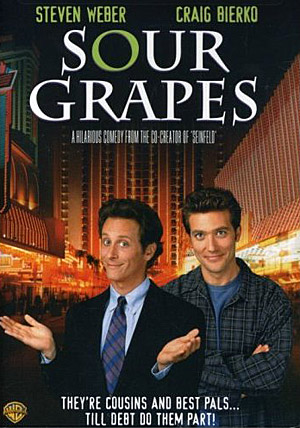
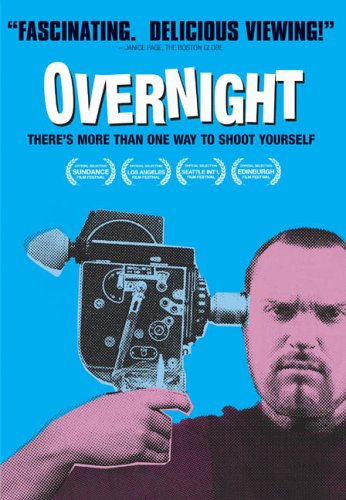
I'm a huge Larry David fan and finally got around to watching his 1998 movie Sour Grapes over the weekend. And it was bad. Like, really bad. So then I also watched Overnight, a documentary that follows the quick rise and fall of Troy Duffy, the writer/director behind The Boondock Saints.

I'd heard about the documentary forever and had been meaning to watch it and was glad to have finally seen it, but I'm not sure I can recommend it. If you're a Boondock Saints fan and really like film (as in you appreciate the behind-the-scenes stuff), then yeah, you might enjoy this. If you didn't care for the movie or didn't even see the movie, then this probably won't interest you. It starts out really good, but then seems to drag on. It made me think of Orson Welles, and how awesome it would have been had Orson had some friends following him around with a camera when he got the amazing deal with RKO and then, eventually, made Citizen Kane. That would have been incredible. But no, instead we have Troy Duffy, who was more arrogant than genius. And if you don't have Netflix (where it's streaming instantly), you can check out the documentary in parts at YouTube, staring with part one. To peak your interest, here is the trailer (don't mind the Dutch subtitles):

httpv://www.youtube.com/watch?v=p-dlNX4AxqM

The 2010 Nobbie Awards

I am extremely proud and happy and honored to learn that the Hint Fiction anthology has been chosen by The Nervous Breakdown as one of the best books of the year. Thank you to TNB, thank you to everyone who has bought a copy, and thank you to everyone who plans to by an extra copy for that special loved one this Christmas. You can see the list of the rest of the awesome books here.

It's All About The He Says She Says Bull ...

As I'm sure I've mentioned before, I love audiobooks. At least audiobooks whose narrators know what they're doing. There are some audiobooks whose narrators are just so terrible that it ruins the story. Oftentimes it's because they have a monotone voice, or they don't put any inflection into the characters' voices, or whatever. And sometimes, it's the book itself that just isn't very good. The audiobook I'm currently listening to is Resolution by Robert B. Parker. It's a western. The narrator is Titus Welliver, who does a decent job. And it's a short book, only four discs, which isn't surprising if you're familiar with Parker's work. And if you are familiar with Parker's work, you know how he likes to incorporate speech tags for every speaking part. Here the opening to the Resolution:

I was in the Blackfoot Saloon in a town called Resolution, talking with a man who owned the saloon about a job. The owner was wearing a brocade vest. His name was Wolfson. He was tall and thin and sort of spooky-looking, with a walleye.

“What’s your name?” Wolfson said.

“Hitch,” I said. “Everett Hitch.”

“How long you been in Resolution?” Wolfson said.

We were at the far end of the big mahogany bar, sipping whiskey that I had bought us.

“’Bout two hours,” I said.

“And you came straight here?” Wolfson said.

“Ain’t that many choices in Resolution,” I said.

“There’s some others,” Wolfson said. “But they ain’t as nice. Tell me about yourself. What can you do?”

“Went to West Point,” I said. “Soldiered awhile, scouted for Wells Fargo, did some marshaling with Virgil Cole.”

And so on and so forth. I don't know at what point in my reading development I started to read-over these unneeded speech tags, but I know it's been years, and when I read a book like this, my eyes automatically skip them. After all, it's obvious who is speaking to whom. If it's not obvious, then yes, a speech tag is needed. But only one or two. Not -- and let's count these, shall we? -- eight in the first 150 words of a novel.

Of course, when listening to an audiobook, you're at the mercy of the narrator, and unfortunately Mr. Welliver goes through every "he said" and "she said" written. Which is expected, yes, but still, it gets real annoying real fast.

Elmore Leonard's famous 10 rules of writing talks about this. It's number 3, actually:

Never use a verb other than "said" to carry dialogue.

The line of dialogue belongs to the character; the verb is the writer sticking his nose in. But said is far less intrusive than grumbled, gasped, cautioned, lied. I once noticed Mary McCarthy ending a line of dialogue with ''she asseverated,'' and had to stop reading to get the dictionary.

And Leonard is, without a doubt, one of the best writers out there, especially when it comes to dialogue. Here's the opening to LaBrava:

“He’s been taking pictures three years, look at the work,” Maurice said. “Here, this guy. Look at the pose, the expression. Who’s he remind you of?”

“He looks like a hustler,” the woman said.

“He is a hustler, the guy’s a pimp. But that’s not what I’m talking about. Here, this one. Exotic dancer backstage. Remind you of anyone?”

“The girl?”

“Come on, Evelyn, the shot. The feeling he gets. The girl trying to look lovely, showing you her treasures, and they’re not bad. But look at the dressing room, all the glitzy crap, the tinfoil cheapness.”

“You want me to say Diane Arbus?”

“I want you to say Diane Arbus, that would be nice. I want you to say Duane Michaels, Danny Lyon. I want you to say Winogrand, Lee Friedlander. You want to go back a few years? I’d like very much for you to say Walker Evans, too.”

“Your old pal.”

“Long, long time ago. Even before your time.”

“Watch it,” Evelyn said, and let her gaze wander over the eight-by-ten black and white prints spread out on the worktable, shining in fluorescent light.

“He’s not bad,” Evelyn said.

Maurice sighed. He had her interest.

See the difference between the two openings in terms of speech tags? Of course you do. And while I love Elmore Leonard and appreciate his ten rules, I don't agree that you must always use "said." There are times when murmur, mutter, whisper, shout, yell, and the like are appropriate. But when in doubt, always use said.

Now, another thing worth mentioning is redundancies in speech tags, but that's a whole ’nother post in itself. Stuff like "I don't understand," he said, confused and "Yes, I think so too," she agreed. See?

*  *  *

On a Hint Fiction related note, I was interviewed by South Coast Today about, well, Hint Fiction.

*  *  *

As the year ends, it means award season is upon us, and Nick Mamatas gives us the cold and hard reality of most major awards. In the comments section he sums it up nicely:

Well, that's the thing to get. You think the Hugos mean something? You think publishing stories in top magazines like Postscripts (where it originally appeared) or Baen's Universe (where it appeared two months later because apparently so few stories out there this one needed immediate reprinting) means a damn thing? You think there are enough intelligent readers out there that such crap when it does get mistakenly published certainly won't be acclaimed? Wrong!

So when you get your stories out there and start blogging for support for the Hugos and Nebulas, what are you doing? You are pointing at that shitty story and saying, "Me too! I should be with that!" When you spend hundreds of bucks on Worldcon and make sure to network with that editor or this agent and be sure to "like" all the right Facebook status updates and line up on one or the other side of a Internet slapfight what you are doing is working to make sure you are counted right next to that story and its Hugo nomination.

It's the cure for King of the Shitheapism.

A Real Life Bond Villain

I try to stay away from politics here on this blog, but I just have to talk about Julian Assange and his "poison pill":

The founder of WikiLeaks has warned that his supporters are primed to publish a 'deluge' of leaked government documents should his activities be curtailed by any country.

Julian Assange has distributed to fellow hackers an encrypted 'poison pill' of damaging secrets, thought to include details on BP and Guantanamo Bay.

He believes the file is his 'insurance' in case he is killed, arrested or the whistleblowing website is removed permanently from the internet.

Sound familiar to anyone? It's like something straight from a James Bond movie! And, well, that's all I have to say about that. Now I'll leave you with a recent cold open of SNL. Enjoy it while you can before the studio suits have it yanked.

httpv://www.youtube.com/watch?v=vFAxIH_H4PI